The Beis Midrash Mind
How Learning Talmud cultivates disciplined, layered, and intellectually honest critical thinking.
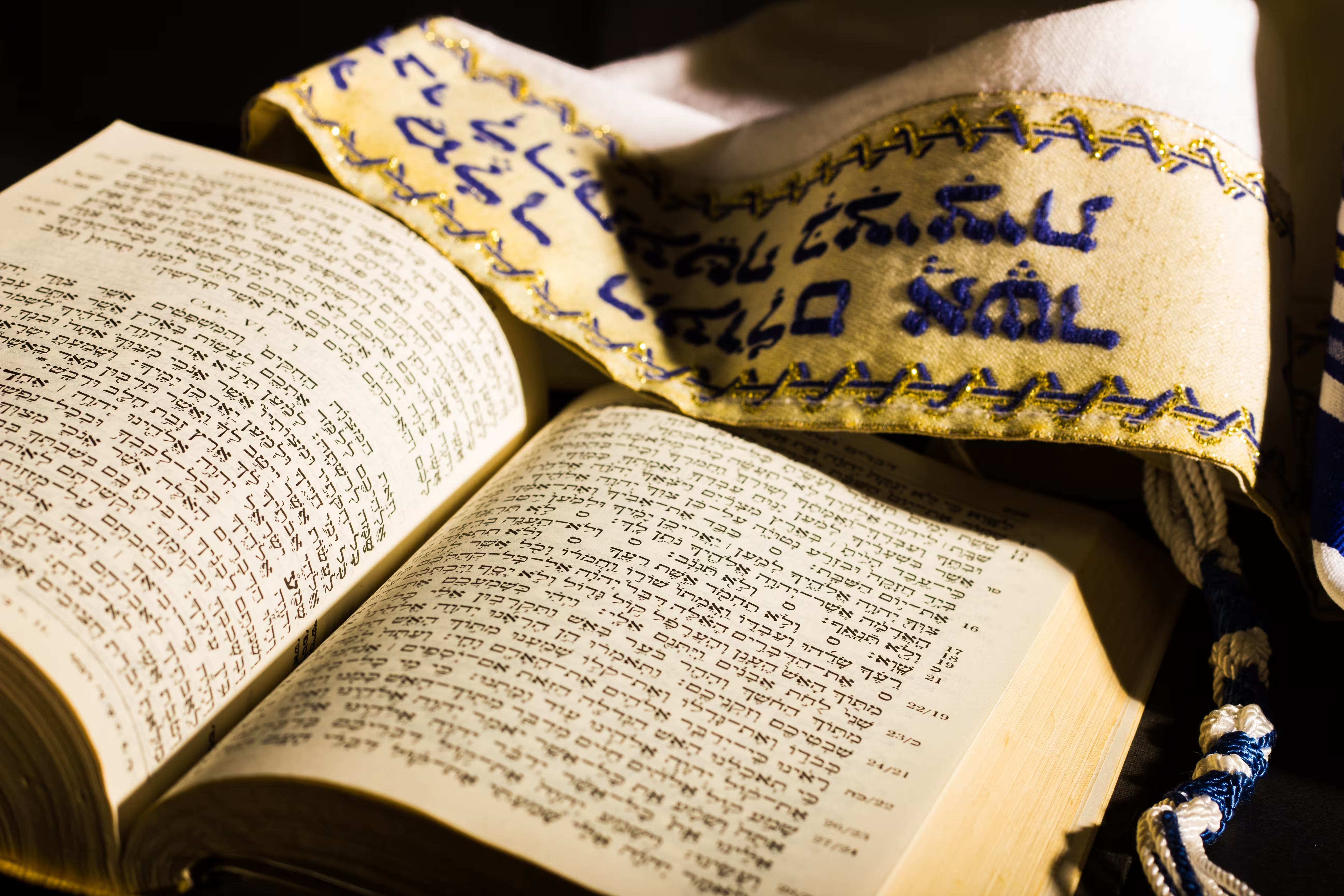
We live in an age that prizes “critical thinking.” Universities promise it. Employers demand it. Podcasts and panels celebrate it. But long before modern academia coined the phrase, the beis midrash was cultivating it — rigorously, relentlessly, and reverently.
As a JETS student, navigating both the beis midrash and the broader world, this is not a contradiction. It is a harmony. Torah does not suppress intellectual development; it refines it. Talmud does not limit critical thought; it trains it at the highest level.
The daf Gemara is not a passive text. It is an argument across generations.
Open any sugya and you will find questions layered upon questions: Mai ta’ama? What is the reason? Peshita? Is this not obvious? Iba’it eima… Perhaps one could say differently. The Talmud does not fear challenge. It invites it. It anticipates objections before you raise them. It demands clarity before it allows conclusions.
This is not memorization. It is mental discipline.
Learning to Think in Layers
In the beis midrash, we are trained to distinguish between surface and substance. A statement is rarely accepted at face value. We analyze: Is this a din d’oraisa or d’rabbanan? Is the reasoning based on a svara (logical principle) or a pasuk (verse)? Is the case comparable, or are we conflating categories?
This layered analysis forms a habit of mind. When a person spends years asking, “What are the underlying assumptions?” or “Is there a nafka mina (practical difference)?” that person does not approach life superficially.
The Talmud teaches us to:
- Define terms precisely
- Identify hidden premises
- Distinguish between similar but distinct cases
- Recognize when an argument is circular
- Detect contradictions and resolve them
These are not only Torah skills. They are life skills.
Machloket as Intellectual Integrity
One of the most remarkable features of Torah Shebe’al Peh is that dissenting opinions are preserved. The Gemara records the view of Beit Shammai even when we rule like Beit Hillel. Why? Because truth in Torah is not fragile. It is strengthened by analysis.
A JETS student who has internalized this understands that disagreement does not equal disrespect. Debate is not hostility. In fact, the Talmud models a profound intellectual humility: we argue fiercely, but we remain bound by shared commitment to emet.
Critical thinking without humility becomes arrogance. Torah-critical thinking remains anchored in yiras Shamayim.
The Courage to Ask
In many environments, questioning authority can be seen as rebellion. In the beis midrash, thoughtful questioning is avodas Hashem. The Rambam himself builds his halachic rulings upon systematic reasoning. Tosafot challenge Rashi. Acharonim question Rishonim — with reverence, but without intellectual passivity.
A student trained in Gemara learns that asking “why?” is not irreverent — it is essential.
This produces individuals who can engage the modern world thoughtfully rather than reactively. When confronted with complex ethical issues, societal shifts, scientific developments, or philosophical challenges, the Torah-trained mind does not panic. It analyzes. It categorizes. It weighs precedent. It seeks primary sources.
The beis midrash is a laboratory for disciplined reasoning.
Precision in Language, Precision in Thought
The Talmud’s attention to language is extraordinary. A single extra word in a Mishnah can generate pages of analysis. Why was this phrasing chosen? What is excluded? What is implied?
This sensitivity to nuance sharpens communication. A person accustomed to parsing the difference between chayav and patur aval assur understands that language shapes reality. In professional life, in law, in medicine, in business, in education — precision matters. Torah trains us not to be sloppy thinkers.
Holding Complexity Without Losing Conviction
Perhaps most importantly, Torah learning teaches us to hold complexity without surrendering clarity.
The Gemara often leaves us with a teiku — an unresolved question. Not every issue is neatly concluded. A Torah mind grows comfortable living with tension while remaining committed to halachic boundaries. This balance is essential for a Modern Orthodox Jew who engages both secular knowledge and eternal tradition.
We are not asked to choose between intellectual rigor and faith. We are asked to elevate our intellect through faith.
Torah as the Foundation of Thought
The Mishnah in Avot teaches: “Turn it and turn it, for everything is in it.” The Torah is not only a source of law; it is a framework for perceiving the world. When we analyze a sugya in Nezikin, we are not merely studying damages. We are absorbing a worldview about responsibility. When we learn Kiddushin, we are not just studying marriage law; we are understanding covenantal relationships.
Critical thinking in Torah is not detached skepticism. It is disciplined analysis guided by moral clarity.
Bringing the Beis Midrash into the World
For those professional careers or leadership roles, recognize the gift you carry. Years of chavruta learning have shaped neural pathways of focus, endurance, and conceptual reasoning. The ability to sit with a difficult Tosafot for an hour develops resilience far beyond the beis midrash.
Do not underestimate what Torah has built within you.
The world may speak about “analytical frameworks.” We have been trained in them since adolescence. The world may champion debate culture. We have lived it respectfully in every shiur.
But we must remember: our goal is not intellectual dominance. It is avodas Hashem.
Torah shapes critical thinking not so that we can win arguments, but so that we can live wisely. It sharpens the mind so that the heart can follow truth more faithfully.
A JETS student stands confidently in both worlds — not because he compartmentalizes them, but because the depth of Torah learning equips him to navigate complexity with integrity.
In an age flooded with information, Torah trains us to seek wisdom.
In a culture of noise, Torah trains us to listen carefully.
In a world of quick takes, Torah trains us to think deeply.
And that, perhaps, is the greatest testament of all: the beis midrash does not only teach us what to think. It teaches us how to think — l’shem Shamayim.
On this page
Our Recent Blogs
Educational blogs for students


Jewish Education
With Real Impact
JETS is a warm, growth-focused Yeshiva, College, and Trade School program for young men seeking to stay connected to Torah and Yiddishkeit while preparing
for a successful future and meaningful parnassah and real-world success.



Over 1,600 Students Have Taken Our Program